
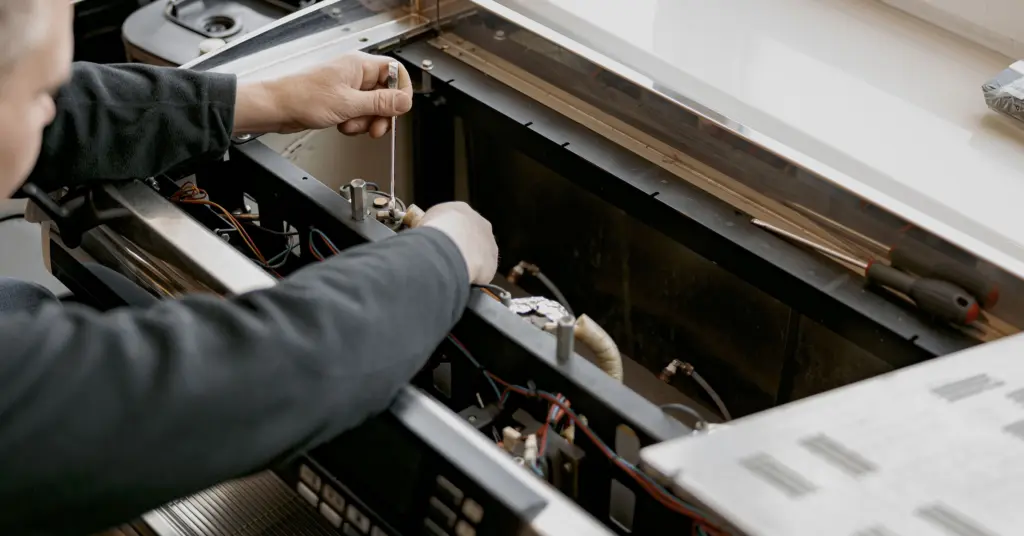
Appliance repair has changed dramatically. Machines that once lasted 20 years are being scrapped at 5. Parts that used to cost a few pounds now run to hundreds. Engineers who once specialised in one brand now have to repair everything. This guide - written from over 40 years of hands-on appliance engineering - gives you the honest picture: when repair makes sense, when it doesn’t, what to expect from engineers, and how to protect yourself when things go wrong.
Book a nationwide appliance repair with NAC Repair
Same-day and next-day repairs across the UK. Qualified engineers, transparent pricing, no hidden charges, all repairs guaranteed. Family-run business with real expertise across all major brands.
Find your appliance fault - diagnosis guides
Start here. Our engineer-written fault guides cover the most common problems across every major appliance type. Most common faults can be narrowed down in minutes, often without calling anyone.
The honest truth about appliance repair
The appliance repair industry has changed fundamentally since the 1980s, and most of the changes have made repair harder, slower, more expensive, and less reliable. Understanding why helps you make better decisions and set realistic expectations.
Washing machines that cost £800 in the 1990s now cost £300 in real terms. But the cost of sending a qualified engineer to your home has risen sharply. The result: many appliances become uneconomical to repair at 4 to 6 years old. A repair that would have cost 10% of replacement value 30 years ago now often costs 40 to 60%. This maths drives the throwaway appliance culture as much as build quality does.
An independent engineer in the 1980s might specialise in one brand and carry every part they were likely to need. Today, most engineers are expected to repair every brand of washing machine, tumble dryer, dishwasher, fridge, freezer, and cooker, sometimes hundreds of different model variants. Many are booked for 8 to 10 calls a day across large geographic areas, leaving little time to properly diagnose complex faults. This is not a criticism of individual engineers, it is the commercial reality of repairing cheap products at prices people will pay.
Some manufacturers deliberately withhold technical documentation, error code explanations, and wiring diagrams from independent engineers. Parts that could be repaired are designed as sealed assemblies that must be replaced whole. This protects manufacturer service revenue but drives up repair costs and reduces the viability of the independent repair trade. The Right to Repair legislation introduced in 2021 has started to address this, but implementation has been uneven.
The majority of appliance faults are straightforward: a blocked filter, a failed pump, a worn belt, a blown element. A competent engineer with the right part on the van can fix these quickly and at reasonable cost. Problems arise when the fault is intermittent, requires a part to be ordered, or is on an uncommon or parts-restricted brand. In these cases, the economics of repair break down rapidly, and the risk of a poor experience rises significantly.
Repair is often the right choice for straightforward faults on appliances under 7 to 8 years old. It becomes progressively less sensible as the appliance ages, the fault becomes more complex, or the repair cost approaches replacement cost. The guidance below helps you make that call clearly.
Should you repair or replace? A practical framework
There is no universal answer, it depends on five factors considered together. Here is how to think through each one honestly.
Consider carefully: 5 to 8 years old, repair 30 to 50% of replacement, moderately complex fault.
Usually replace: Over 8 years, repair over 50% of replacement, complex fault such as bearings, PCB, or motor.
Always check first: Consumer rights, may cost you nothing.
Manufacturer engineer or independent? Which is better?
Consumer group testing has consistently found that independent repairers typically offer faster service, lower charges, and comparable or better quality than manufacturer service networks. But the picture is more nuanced than that headline suggests.
✅ Manufacturer engineer - advantages
Genuine parts only, no inferior copies. Brand-specific technical knowledge and access to latest service bulletins. Formal complaints procedure if the repair goes wrong. Likely to have correct parts on the van for their own brand. Fixed-price schemes offer cost certainty, though often expensive.
❌ Manufacturer engineer - disadvantages
Significantly higher call-out and labour charges. Less personal service, engineers cover large areas with many calls per day. Appointment times can be inflexible, sometimes a week or more wait. Engineers now cover multiple brands, reducing the specialisation advantage. Short guarantee periods on repairs, sometimes as little as 3 months.
✅ Independent engineer - advantages
Labour charges typically 30 to 50% lower than manufacturer rates. Usually faster availability, often same or next day. Sole traders have a strong personal incentive to do the job well, their livelihood depends on local reputation. More flexible with appointment times. Often more willing to spend time properly diagnosing an unusual fault.
❌ Independent engineer - disadvantages
Variable quality, the difference between an excellent and a poor independent is significant. May not have brand-specific technical information for manufacturers who restrict it. May use non-genuine parts, though often perfectly adequate. No oversight body for sole traders if the repair is poor or disputed. May not carry the right parts for unusual faults, requiring a return visit.
For most common faults on mainstream appliances, a well-recommended local independent engineer is the best option, faster, cheaper, and with a personal stake in getting it right. For complex faults on premium brands, or where technical information restriction is a factor, the manufacturer network may be necessary. Read more: manufacturer vs independent engineer - full comparison.
What to do before calling an engineer
A significant proportion of appliance call-outs are for faults that the owner could have resolved themselves, or that are not faults at all. Working through these checks before booking saves money and avoids unnecessary waiting.
Understanding repair charges - what you will actually pay
Repair pricing is more complex than it appears, and some of the most common advertising phrases like “no call out charge” and “free estimate” are widely misunderstood in ways that can lead to unexpected bills.
Read more in our detailed guides: no call out charge explained, are free estimates free?, and need an urgent same-day repair?
DIY appliance repair - safety, parts, and what to attempt
Many common appliance faults can be fixed by a competent non-specialist with the correct part and the right information. But the line between a safe DIY repair and a dangerous one is not always obvious.
Never work on any appliance that is connected to the mains electricity supply. Disconnect at the wall and wait for capacitors to discharge before opening any panels. This applies even to “simple” tasks. Gas appliances, cookers, hobs, and gas tumble dryers, must only be worked on by a Gas Safe registered engineer. No exception.
Sourcing spare parts - getting it right
Ordering the wrong part is one of the most common and costly DIY repair mistakes. Here is how to get it right first time, and what to watch out for.
Book a professional repair - nationwide
When the fault needs a professional, choosing the right service matters. Whitegoods Help recommends NAC Repair for nationwide coverage, transparent pricing, experienced engineers, and all repairs guaranteed.
Ready to book?
Book your repair with NAC Repair - fast, transparent, guaranteed.
More repair guidance from our engineers
Your rights - before you pay for any repair
The Consumer Rights Act 2015 is one of the most useful and least-used pieces of consumer legislation in the UK. Before authorising any repair or replacement at your own expense, spend five minutes understanding whether the cost should be the retailer’s legal obligation, not yours.
If your appliance developed a fault within the first six months of purchase, the law presumes it was an inherent fault unless the retailer can prove otherwise. You do not have to prove anything, they do. This applies regardless of the manufacturer’s guarantee period.
The six-year limit: You have up to six years (five in Scotland) to bring a claim against the retailer for an appliance that has not lasted a reasonable time. The difficulty of making a successful claim increases over time, but the right exists throughout.
Frequently asked questions
How do I know if my appliance is worth repairing?
Consider age, fault type, repair cost, and brand. If the repair is likely to cost more than 50% of a replacement, replace. If the appliance is in the last third of its expected lifespan, replace unless the repair is very cheap. If it is relatively young with a simple fault, repair. Always check your consumer rights before spending anything, the retailer may be legally obliged to cover it. Read our full guide: out of guarantee, your rights.
Is it safe to attempt appliance repairs myself?
Some tasks like cleaning filters, replacing door seals, fitting a new pump or heating element are within the capability of a careful non-specialist with the right part and instructions. Anything involving live electrical components, gas connections, or sealed refrigerant systems must only be handled by a qualified engineer. The absolute rule: disconnect from the mains before touching anything inside the appliance. Read: DIY repair safety tips.
What does “no call out charge” actually mean?
“No call out charge” means the engineer will not charge specifically for travelling to your home. It says nothing about the charge for diagnosing the fault once inside, which can be just as significant. The critical question to ask before booking is: “If the appliance turns out to be beyond economic repair, how much will I owe?” Get the answer in writing. Read: what does no call out charge mean?
Should I use the manufacturer’s own engineer or an independent?
For most common faults on mainstream appliances, a well-recommended local independent engineer is faster, cheaper, and often produces better results. The manufacturer’s own network has advantages for complex faults on premium brands, or where technical information restriction limits what an independent can do. Consumer group testing has consistently found independents offer better value overall. Read the full comparison: manufacturer vs independent engineer.
The repair didn’t fix the problem - what are my rights?
If a repair has failed to resolve the original fault, or has caused further damage, you have a claim against the repair company. Ask for a written explanation of what was done and what the remaining fault is. If the repair company is unresponsive, escalate through Citizens Advice, Resolver, or the small claims court. If the original repair caused new damage, document it thoroughly, photographs taken immediately are essential evidence. Read: claiming compensation from a retailer or repairer.
Can I get spare parts for an older appliance?
For most mainstream appliances under 10 years old, spare parts are available through independent spare parts suppliers. Beyond 10 to 12 years, availability becomes patchy, particularly for less common brands or models. You will need the exact model number to order correctly. Some manufacturers restrict parts supply to inflate service revenue, this is one of the issues the Right to Repair legislation is designed to address. Read: Spare Parts Shop.