
How to disconnect a washing machine (and unplumb it safely)
Whether the old machine is going out for a new one, coming with you to a new home or being pulled out for a repair, disconnecting it is a job most people can do in under an hour. Done in the right order, with the right caps to hand, nothing floods. This guide goes through it step by step: power, water, draining, hoses, caps and transit bolts. It also says when to stop and call someone.
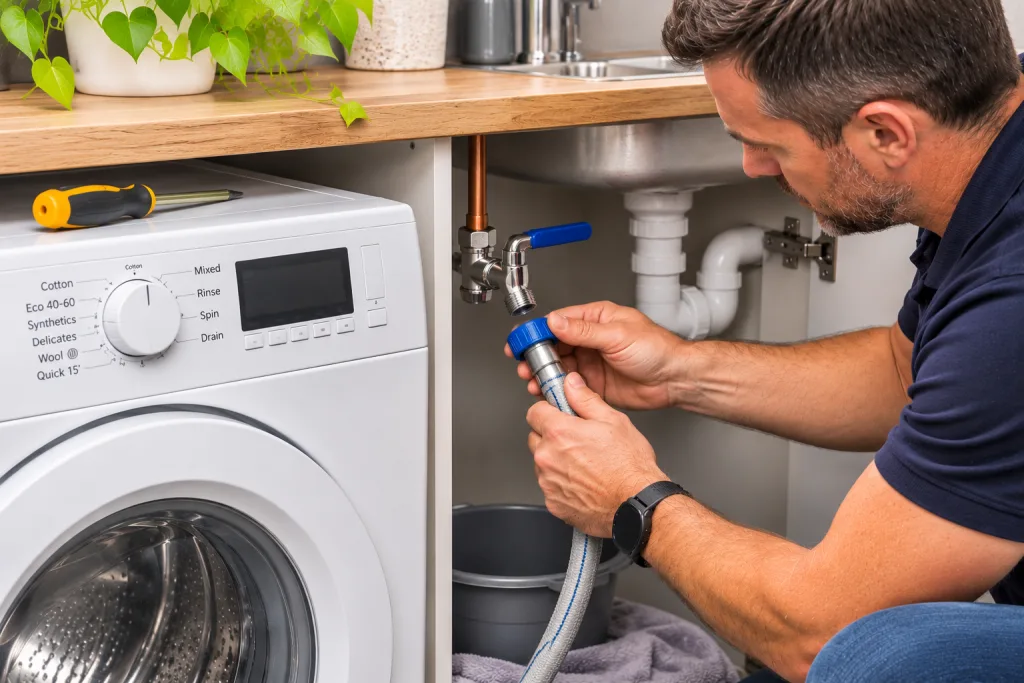
Unplug the machine, or switch it off at the wall, before you touch a hose, and keep the plug and any sockets away from the water you drain out. If the machine has no plug and its cable goes straight into a fused spur, it is wired in. Leave that connection to an electrician or engineer and don't open the faceplate yourself.
01Before you start: what you'll need
The job itself is simple. What goes wrong is usually water: a hose full of water emptied onto the floor, a pump filter that lets out more than the tray can hold, or an uncapped sink waste that floods the cupboard the next time somebody does the washing up. Have everything ready first and none of that happens.
- Old towels, enough to cover the floor in front of the machine and under the taps
- A shallow tray, such as a roasting tin or baking tray. The pump filter sits a few centimetres off the floor, so a bucket won't fit under it
- A bucket for the hose ends
- A flat-blade screwdriver, for an isolating valve with a slot instead of a lever
- A ¾ inch blanking cap with a rubber washer for each washing machine tap you are leaving behind
- A blanking cap or bung for the sink waste spigot, if the drain hose goes into the U-bend under the sink
- The transit bolts, if you still have them and the machine is being moved or stored
- A torch, and your phone to take photos
Take a photo of the taps, the hoses and the drain connection before you start. It shows you, a plumber or whoever fits the next machine how it was all connected, which tap was which, and how the drain hose was routed.
If you are replacing the machine in the Black Friday sales, ask the retailer before delivery day whether its crew will disconnect the old machine, or whether they expect it disconnected and drained and ready to take away. Ask too whether there is a charge. Doing the job the evening before saves a rushed delivery slot.
02Turn off the power and the water
Power
Switch the machine off and pull the plug out of the socket. If the socket is behind the machine and you can't reach it, there is often a switched fused spur above the worktop that controls it. Switch that off, then unplug the machine once you have pulled it out.
Check which kind you have:
Plug in a socket
The machine has an ordinary plug in a socket, and a switch on the wall may control that socket. Switch off and unplug. You can do the whole job yourself.
Wired into a spur
The cable runs straight into a fused connection unit with no plug. Switching the spur off makes the machine safe to work round, but taking the cable out means opening an electrical fitting. Leave that to an electrician or engineer.
Water
The washing machine tap is usually under the sink, in the cupboard next to the machine, or on the wall behind it. Modern machines are cold fill, so there is normally one tap, usually with a blue lever. Older machines and some older plumbing have a hot tap as well, usually red.
Most of these taps are quarter-turn valves. A quarter turn shuts the water off fully. The lever lies along the pipe when it is open and across the pipe when it is closed. Some have a screwdriver slot instead of a lever, and the rule is the same: turn it a quarter of a turn until the slot sits across the pipe.
- Turn the lever or slot a quarter turn until it sits across the pipe. It should stop firmly. Don't force it past the stop.
- Turn off the hot tap too if there is one, even if the machine is cold fill. You will be capping both.
- If the tap is behind the machine, ease the machine forward a little, just far enough to reach it. Don't pull hard on the hoses. See what's the best way to pull a washing machine out.
Washing machine taps can go for years without being touched and seize with limescale. A little firm pressure is fine. Don't use pliers, a wrench or a hammer on it: the lever or spindle can snap, the valve can start leaking round the spindle, or you can twist the pipe and loosen a joint further back. If it won't move, turn the water off at the main stopcock (in many homes it is under the kitchen sink), finish the job, and have a plumber replace the valve before the next machine goes in.
03Let out the water left inside
A washing machine that has finished its last wash is not empty. Water stays in the sump, the pump and the bottom of the drain hose. Take it out now, while the machine is still standing where it is and the floor is protected.
- Wait if the machine has just run a hot wash. Let the water cool before you open anything.
- Find the pump filter. It is usually behind a small flap or panel at the bottom front corner. Some machines have it behind a kick strip across the bottom.
- Lay towels down and slide the tray under the filter.
- Use the emergency drain hose if there is one. Many machines have a short, thin hose next to the filter. Pull it out, hold the end in the tray, pull out its little bung and let the water run. Put the bung back to stop the flow while you empty the tray.
- If there is no drain hose, unscrew the filter slowly, a little at a time, so the water comes out at a pace the tray can take. Close it again whenever the tray is nearly full.
- Take the filter right out once the water stops, clean off any fluff, coins or hair clips, and screw it back in firmly. A filter left loose will leak on the next wash, wherever the machine ends up.
It often takes several trays to empty the machine, and the last of it trickles out slowly. Tipping the machine back very slightly once the flow stops lets out a little more. Our guides to draining a washing machine and the washing machine pump filter go into more detail, including what to do if the filter won't unscrew.
Why it must be empty if it's going in a van
Water left inside slops about on the journey. It can run out of the drain hose or the filter area onto the van floor and your other things, and inside the machine it can splash onto the motor and wiring. If the machine is going into storage, water left in the pump and hoses can go stale and smell, and in an unheated garage or storage unit it can freeze and crack the pump. So drain it fully, and leave the door and the detergent drawer open for a day so the inside dries. See how to store a washing machine.
04Disconnect the fill hose
The fill hose screws onto the washing machine tap with a plastic or metal nut. Even with the tap off, the hose is still full of water and may be under a little pressure.
- Put the bucket under the tap and a towel round the joint.
- Unscrew the hose nut at the tap end by hand, turning it anticlockwise as you look at the tap outlet. If it is tight, a pair of grips with a cloth round the nut gives you more grip without crushing it. Hold the tap body still with your other hand so you don't twist the pipe.
- Expect a short spurt as it comes free. Point the hose end straight down into the bucket and let it drain.
- Keep the rubber washer. It sits inside the hose nut. If it has dropped out, look for it on the floor.
- Leave the hose on the machine if the machine is being moved or stored, and tape or tie the loose end to the back so it doesn't drag. If the machine is being scrapped and the new one comes with its own hoses, unscrew the hose from the machine end too and drain it into the bucket.
- Do the same for the hot hose, if there is one.
Aquastop and other anti-flood hoses
Some machines, Bosch and Siemens among them, have an Aquastop or similar flood-protection hose. It has a large plastic box at the tap end, which holds the safety valve. Read about how they work in our guide to aqua stop hoses.
Unscrew it by the nut or collar at the tap connection, not by twisting the box. Don't cut the hose, drop the box in a bucket of water or try to take it apart. On many designs the safety device is part of the hose and can't be replaced on its own, so a damaged one means a new hose. If you are unsure how yours comes off, the manual for the machine shows it.
Cap the tap outlet
Turning the tap off is not enough on its own. A lever under a sink or in a cupboard is easily knocked by a bin, a bag or a child, and an open outlet on mains pressure floods a kitchen quickly.
Screw a ¾ inch blanking cap onto each tap outlet you have disconnected, hand-tight with its rubber washer in place. They are cheap from plumbers' merchants and DIY stores, and often sold as "washing machine blanking caps" or "hose blanking caps". If the old hot tap won't be used again because the new machine is cold fill only, see how to blank off the old hot water tap for the options, including taking it out altogether.
05Disconnect the drain hose
The drain hose goes either into a standpipe (an open upright pipe behind or beside the machine) or onto a spigot on the U-bend under the kitchen sink. The bottom of the hose holds some dirty water, so keep the bucket handy.
From a standpipe
- Lift the hose straight up out of the standpipe, holding the plastic hook or crook that keeps it in place.
- Lower the end into the bucket straight away and let it drain.
- Leave the standpipe as it is. It has its own trap, so it doesn't need capping. If it will be out of use for more than a few weeks, cover the top loosely, or pour a jug of water down it now and then. That keeps the water in the trap so drain smells don't come up.
From the sink spigot
The spigot is the short angled pipe sticking out of the sink's U-bend or waste pipe. The drain hose is pushed onto it and usually held with a clip or a jubilee clip.
- Put the bucket and a towel under the spigot.
- Loosen the clip. A spring clip squeezes open with pliers. A jubilee clip unscrews with a flat-blade screwdriver.
- Twist the hose gently and pull it off. If it has been on for years, work it round a little at a time rather than yanking, because a cracked spigot means a new trap.
- Drain the hose into the bucket.
- Cap the spigot straight away (see below).
Once the drain hose is off, the spigot is an open hole into the sink waste. The next time somebody runs the tap, empties the washing up bowl or uses the dishwasher on the same trap, that water comes straight out of the spigot into the cupboard. Fit a blanking cap or bung before anybody uses the sink, and tell the rest of the household.
Blanking caps and push-in bungs for sink spigots are sold at plumbers' merchants and DIY stores. Spigots differ in size from one make of trap to another, so measure across the end of yours or note the make before you buy. If the new machine is going in within the day, keeping the sink out of use for that time will do. Some newer traps have a spigot that was sealed with a thin blanking piece when new, which was cut out when the first machine was fitted. That can't be put back, so it needs a cap.
If you are connecting a replacement straight away, you won't need caps at all: the new hoses go on where the old ones came off. Our guide on how to install a washing machine takes you through it, from the transit bolts to the leak checks.
06Pulling the machine out without damage
A washing machine is heavy, mostly because of the concrete counterweights round the drum. It is also top-heavy and has thin feet that dig into vinyl and chip tiles.
- Protect the floor first: an old piece of carpet, upside down, or a sheet of hardboard in front of the machine lets it slide without scratching
- Walk it out: tilt it slightly and swing one front corner forward, then the other, a few centimetres at a time
- Don't pull it by the door, the door seal or the top panel, as they aren't made to take the weight
- Watch the hoses and the cable as it comes out, so they don't catch on a cupboard plinth, a pipe or the tap
- Tie the hoses and cable to the back of the machine, so they can't be trodden on, trapped under a foot or kinked
- Get help if it is built in under a worktop or you have to lift it over a lip in the floor
- Keep it upright: don't lay it on its front or back to carry it
For more on getting a stuck machine out from under a worktop, see what's the best way to pull a washing machine out.
07Refit the transit bolts if it's moving
Transit bolts are long bolts that go through the back of the machine and lock the drum in place. Inside, the drum hangs on springs and shock absorbers. If it isn't held still, the jolts of a van or of being carried down stairs swing it hard against the cabinet and can damage the suspension, the drum or the parts around it.
- Find the bolts. With luck they were kept in a drawer or taped to the back of the machine when it was installed.
- Remove the plastic caps that cover the bolt holes in the back panel.
- Line the drum up. You may need to lift or move the drum a little by reaching through the door, so the bolts find their holes inside.
- Screw the bolts in fully, with any plastic spacers that came with them, until the drum doesn't move.
- Write "transit bolts fitted" on the front with a sticky note, so the bolts are taken out before the machine is used again.
Moving it from one room to the next on a flat floor doesn't need them. A van journey, stairs, or a long period in storage does. If you are moving house, moving appliances - UK guide and transporting a washing machine cover the rest of the move.
Transit bolts differ between makes and models, so random bolts from a hardware shop won't do. Find the model number on the label inside the door or on the back, and look for the right bolts in our parts shop by model number, or ask the manufacturer. If you can't get them in time, keep the machine upright, pack it so it can't tip or slide, and drive gently. That cuts down the risk, but it doesn't remove it.
A machine run with its transit bolts in will shake violently on spin and can be badly damaged. Remove them before it is used again, and keep them for the next move.
08When to call a plumber or engineer
Most people can disconnect a washing machine themselves in under an hour. Stop and get help if any of these come up:
- The isolating valve won't turn without force, or the lever is broken. Turn off the main stopcock and call a plumber to replace the valve
- The valve drips or keeps running once it is turned off, at the outlet or round the spindle. A valve that doesn't close fully can't be capped safely
- An old hot-fill tap won't shut off fully. Hot taps scale up more than cold ones. Turn off the hot supply or the main stopcock and get a plumber to replace or remove it
- The pipe joints are green or white and crusty round the brass nuts, or there are signs of an old leak. Corroded compression joints can start leaking when they are disturbed, and that includes turning a stiff valve next to them
- The machine is wired into a fused spur with no plug. Get an electrician or engineer to disconnect it
- You smell burning, or the plug or socket is scorched or discoloured. Don't use that socket. Have it checked by an electrician
- The pump filter won't unscrew, or water keeps pouring out after the filter is out. A washing machine engineer can drain it properly
If the machine is coming out for a repair rather than a move, an engineer can usually disconnect it as part of the visit. Find a washing machine engineer near you.
Do I need a plumber to disconnect a washing machine?
Usually not. If the machine plugs into a socket, the tap turns off easily and the fittings are in good condition, you can do it yourself with towels, a tray, a bucket and a couple of blanking caps. Call a plumber if the valve is seized, drips once it is off, or the joints round it are corroded. Call an electrician if the machine is wired into a fused spur instead of plugged in.
What size blanking cap do I need for a washing machine tap?
Washing machine taps in the UK have a ¾ inch threaded outlet, the same size as the hose nut, so you need a ¾ inch blanking cap with a rubber washer inside. They are sold at plumbers' merchants and DIY stores.
Can I leave the washing machine tap turned off without a cap?
It is not a good idea. The tap is the only thing holding back mains pressure, and levers in cupboards get knocked. A cap costs very little and means an accidental turn of the lever does nothing.
Can I use the kitchen sink after taking the drain hose off?
Not until the spigot on the U-bend is capped or bunged. Otherwise water from the sink, and from a dishwasher on the same trap, runs straight out of the open spigot into the cupboard.
How much water will come out of the pump filter?
More than most people expect, and it varies from machine to machine. Plan for several shallow trays and plenty of towels, and let it out slowly. A machine that finished its last wash with an error or didn't drain can still have most of a drum of water in it, so check through the door glass first.
Do I need to refit the transit bolts if I'm only moving it to another room?
Not for a short move across a flat floor in the same house. Refit them for a van journey, for carrying it up or down stairs, or for putting it into storage, because those are when the drum gets thrown about.
Still not fixed?
Here’s where to go next.
0 Comments